
Voyager 1 One Light-Day Away: NASA Probe Makes Space History
Voyager 1 is now one light-day from Earth, about 25.9 billion km away. What the record means, the latest NASA update and fun space facts for kids.

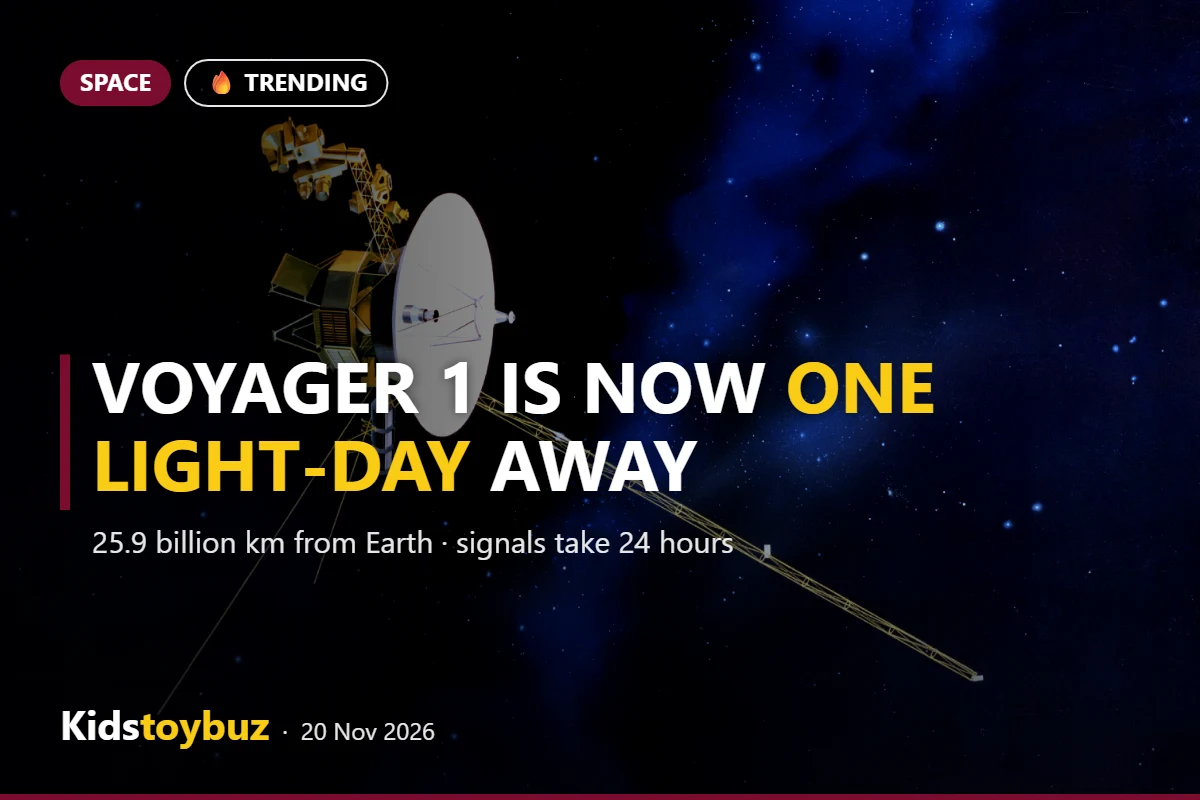
Imagine making a phone call that takes a whole day to reach the other person. That is now everyday life for NASA’s engineers, because Voyager 1 is one light-day from Earth. On 18 November 2026 at about 3:46 PM IST, the 49-year-old probe crossed a distance so huge that its radio signals, travelling at the speed of light, need a full 24 hours to get home. No spacecraft has ever been this far away.
Key Highlights: Voyager 1 One Light-Day Milestone
- Voyager 1 reached one light-day (about 25.9 billion km) from Earth on 18 November 2026.
- A message sent to it takes 24 hours to arrive, and the reply takes another 24 hours.
- It was launched on 5 September 1977 and is still talking to Earth after 49 years.
- Engineers are currently fixing a data problem that began on 14 November, but it did not affect the record.
- It carries the famous Golden Record, a message from Earth for anyone who might find it.
What Does “One Light-Day Away” Mean?
Light is the fastest thing in the universe. It zooms along at nearly 3 lakh kilometres every second, fast enough to go around Earth more than seven times in one second. A light-day is simply how far light travels in one full day: roughly 25.9 billion kilometres.
Sunlight reaches us in about eight minutes. Radio signals from Voyager 1 now need 24 hours. So when the team sends a command on Monday morning, the spacecraft only “hears” it on Tuesday morning, and the answer lands back on Wednesday.
A Fun Way to Picture It at Home
Ask your child to take one big step and call it the distance from the Sun to Earth. On that scale, Voyager 1 would be about 173 steps away. Now walk it together down a corridor or in the park, and the vastness of space suddenly feels real.
Voyager 1’s Amazing Journey Since 1977
Voyager 1 blasted off from Cape Canaveral in Florida on 5 September 1977, 16 days after its twin, Voyager 2. Its first job was to visit the giant planets. It flew past Jupiter in March 1979 and Saturn in November 1980, sending back close-up pictures that amazed the world.
Then it simply kept going. In February 1998 it overtook Pioneer 10 to become the most distant human-made object. On 25 August 2012 it left the Sun’s bubble of solar wind, called the heliosphere, and became the first spacecraft to enter interstellar space, the region between the stars.
| Fact | Details |
|---|---|
| Milestone reached | 18 November 2026, about 3:46 PM IST (10:16 UTC) |
| Distance from Earth | About 25.9 billion km (16.1 billion miles) |
| One-way signal time | About 24 hours |
| Speed | About 61,000 km per hour |
| Launch date | 5 September 1977 |
| Entered interstellar space | 25 August 2012 |
| Power source | Three nuclear batteries (RTGs), losing about 4 watts a year |
| Working science instruments | Two: magnetometer and plasma wave instrument |
Is Voyager 1 Still Working? The Latest NASA Update
Mostly, yes, but it has been a bumpy month. On 14 November, a giant antenna in Canberra, Australia, picked up Voyager 1’s signal but no science or engineering data came with it. NASA says the spacecraft is still pointing at Earth and its radio still works, so the problem is probably in the onboard computer that packs up data for sending.
Engineers have seen something similar before. In 2023 Voyager 1 had a comparable glitch, and the team fixed it with clever software changes sent from 24 billion kilometres away. Because every message takes a day each way, NASA says this new diagnosis could take weeks. The good news: the light-day record could not be affected, because Voyager 1 cannot speed up or slow down. It just glides on.
Did you know? Voyager 1 carries a 12-inch gold-plated copper record with 115 pictures, greetings in 55 languages, sounds of waves, wind, thunder, birds and whales, and about 90 minutes of music from around the world. NASA expects it to last more than a billion years.
Why Voyager 1 Is Trending in India
Searches for “NASA Voyager 1” jumped across India after NASA confirmed the light-day crossing on 19 November. Indian families have a big love for space thanks to missions like Chandrayaan, and a probe older than many parents still sending messages from beyond the planets is a story children instantly connect with. The suspense over the data glitch has kept people checking for news too.
What Happens Next for Voyager 1?
NASA’s team listens to Voyager 1 every day and sends commands about once a week. Their first job is to fix the data problem. After that, the main challenge is power: the nuclear batteries weaken each year, so engineers keep switching off heaters and instruments to save energy.
- September 2027: Voyager 1 turns 50, and NASA hopes both probes will still be doing science.
- Early 2030s: the team expects enough power to keep talking to Earth until about then.
- November 2035: Voyager 2, now about 20 light-hours away, should reach its own one light-day mark.
Tip for families: NASA’s free “Eyes on the Solar System” website shows where both Voyagers are right now in 3D. It makes a great after-dinner space adventure with kids.
FAQs About Voyager 1
How far is Voyager 1 from Earth now?
About 25.9 billion km, which is one light-day. It is the farthest spacecraft ever, and the distance grows by roughly 61,000 km every hour.
How long does a message from Voyager 1 take to reach Earth?
About 24 hours. A question and its answer together take roughly two days.
Is Voyager 1 still working in 2026?
Yes. It still sends a signal home, but since 14 November its data has not been coming through, and NASA engineers are working on a fix.
Will Voyager 1 ever stop?
It will stop talking when its power runs out, probably in the 2030s, but it will keep drifting through space for billions of years with its Golden Record.
A Tiny Probe With a Giant Story
Voyager 1 was built with far less computing power than a modern smartphone, yet it has outlived almost every machine of its time and gone farther than anything humans have made. It is a wonderful reminder for children that curiosity, patience and teamwork can take you a very long way. If your little explorer is now dreaming of rockets, our parent’s guide to STEM toys and the hands-on DIY Rocket Launcher STEM Kit are perfect next steps.
Come back to our Trending News section tomorrow for more stories your family will love.
Cover photo: NASA/JPL / Wikimedia Commons, Public domain (edited with text overlay)