STEM Toys Explained: A Parent’s Guide to Raising Little Problem-Solvers
What exactly are STEM toys, and are they worth it? We break down what to look for at each age, plus simple ways to make science and building play part of everyday life.

STEM stands for Science, Technology, Engineering and Maths. STEM toys invite children to experiment, build, test ideas and spot patterns — skills that help in every subject, not just science.
What counts as a STEM toy?
You don’t need anything high-tech. Many of the best STEM toys are simple:
- Science: experiment kits, magnifying glasses, magnets, growing kits
- Technology: simple circuits, screen-free coding games
- Engineering: building blocks, construction sets, marble runs
- Maths: pattern tiles, counting games, puzzles and dominoes
The best STEM toys by age
Ages 2–4
Focus on sorting, stacking and cause-and-effect. Big blocks, shape sorters and water play are ideal first “experiments”.
Ages 4–7
Children can follow simple steps and love “magic” results. Beginner kits such as the Smartivity Magic Science Kit or magnetic pattern tiles build early reasoning.
Ages 8 and up
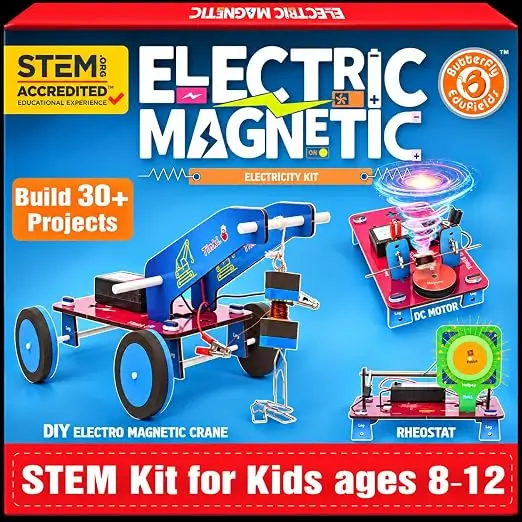
Now they can tackle multi-step projects on their own. A kit like the Butterfly EduFields 30-in-1 STEM kit introduces circuits and magnetism through hands-on builds.
What to look for when buying
- Clear instructions with pictures, so your child can work independently.
- Several projects in one box for better value and longer interest.
- Real results — something that lights up, moves or changes colour.
- Age-appropriate safety, especially for kits with chemicals, batteries or small parts.
Parent tip: before starting a kit, ask your child to guess what will happen. Afterwards, ask “Were you right? Why or why not?” That’s the scientific method in two questions.
Everyday STEM, no kit required
- Bake together and talk about measuring and how heat changes ingredients.
- Build a paper bridge between two books and test how many coins it holds.
- Float and sink different objects in a bowl of water.
- Count, sort and graph the colours of toy cars.
How to help without taking over
It’s tempting to jump in when a model won’t stand up or an experiment fizzles. But the learning happens in the struggle, so try to be a helper rather than the builder:
- Ask before you fix. “What do you think went wrong?” is more useful than showing the answer.
- Let mistakes happen. A bridge that collapses teaches more about structure than one that works first time.
- Read the instructions together, then let your child lead the steps they can manage.
- Praise effort and ideas, not just the finished result. “You tried three different ways!” builds persistence.
STEM is for every child
Children decide very early what they think they are “good at”. Offer building sets, science kits and puzzles to every child, whatever their interests, and talk about the scientists, engineers and inventors behind everyday things. A child who loves art might enjoy circuits that light up a drawing; a child who loves stories might enjoy building a set for their toys.
Screens, apps and coding toys
Coding apps and robot toys can be a fun introduction to technology, but you don’t need a screen to learn computational thinking. Many screen-free games teach the same ideas: following a sequence, spotting patterns and fixing “bugs”. If you do choose an app or robot, look for ones where the child is creating something rather than just tapping through levels, and play alongside them at first.
Common mistakes to avoid
- Buying too advanced. A kit labelled for older children can quickly lead to frustration. It’s better to finish an easier kit and want more.
- Doing every project in one sitting. Spread multi-project kits over weeks to keep the excitement going.
- Forgetting the basics. Blocks, puzzles and brain games build the same skills as expensive gadgets.
- Skipping safety notes. Read the warnings on science kits, and supervise anything involving heat, chemicals, sharp tools or small magnets.
Browse our educational and STEM toys for kits organised by age and interest.
Keep it playful
The goal isn’t to create a future engineer by age six — it’s to keep curiosity alive. Let your child lead, celebrate failed experiments as discoveries, and keep the pressure low.